GPS tracker or school bus tracking app: what does your school actually need?
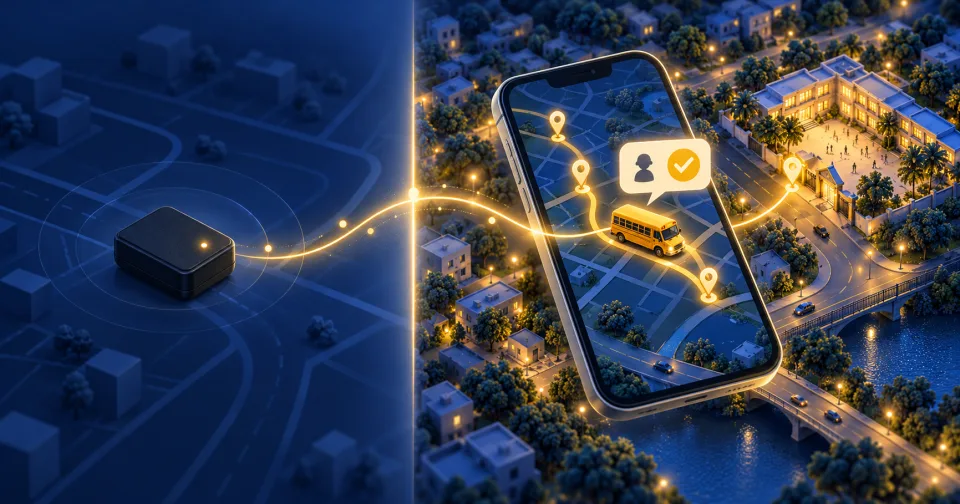
A GPS box tells you where the bus is. Parents want to know where their child is. Here is the difference, a side-by-side comparison, and five questions to decide.
On this page
The short version
- A GPS tracker tells you where the bus is. A school bus tracking app also tells parents where their child is: on board, dropped, or not picked up.
- Most parent phone calls are about the child, not the bus. That is the gap a tracker alone cannot close.
- Many schools need both: an AIS-140 tracker for compliance, and an app on top for attendance, alerts and parents.
When a school decides to "add tracking", the first quote usually comes from a GPS vendor: a small box wired into the bus, a web map for the office, and a yearly SIM fee. It is cheap and it works. Then the first week of use teaches a lesson every transport manager learns: parents do not call to ask where the bus is. They call to ask where their child is.
This guide explains the difference between a plain GPS tracker and a school bus tracking app, what each one is good at, and a simple way to decide what your school actually needs.
What a GPS tracker does
A vehicle tracker is a device fitted in the bus that reports its location every few seconds over a mobile network. In India, trackers for commercial and public service vehicles are built to AIS-140, the national standard that also covers emergency (panic) buttons and sending data to a government monitoring system. Some states now require school buses to meet it; Maharashtra's 2026 school bus rules, for example, ask for AIS-140 compliant tracking linked to the state platform.
A good tracker gives the school office:
- a live map of every bus and its speed
- route history, to check a complaint about a late or rash trip
- alerts for over-speeding or a bus leaving its route
- a panic button the crew can press in an emergency
That is useful, and in many places it is a legal requirement. But notice what is missing: the tracker knows nothing about the children.
What a school transport app adds
A school bus tracking app connects the bus to the people in it. Typically it adds:
- Child-level attendance. Each child is marked when they board and get down, usually with a QR card or ID scan, so the school knows who is on which bus right now.
- Parent alerts. A parent gets a message when the bus is near, when their child boards, and when the child reaches school or home.
- Safe handover. At drop-off, the child is handed only to a parent or an authorised person, and the handover is recorded.
- Exceptions. If a child is absent at the stop or does not reach school, the right person is told straight away instead of hours later.
- One record. Routes, stops, children, drivers and attendance live in one place, which is what an inspection or a worried parent asks for.
Side by side
| Question | GPS tracker | Transport app |
|---|---|---|
| Where is the bus right now? | Yes | Yes |
| Is my child on the bus? | No | Yes |
| Did my child reach school? | No | Yes, with an alert |
| Who collected my child at drop? | No | Yes, recorded |
| Speed and route history | Yes | Usually yes |
| Panic button / state platform link | Yes, if AIS-140 | Depends on the app |
| Digital boarding records for inspection | No | Yes |
| Fewer parent calls to the office | A little | A lot |
The hidden cost of "just a tracker"
Trackers look cheaper on paper. The cost that does not appear on the quote is the people time around them. If the office has to answer "has the bus reached?" calls every morning, or a teacher has to keep a paper register on every trip, that time adds up quickly over a school year. And paper records are hard to search when someone asks what happened on a particular day.
The other hidden cost is risk. A child who did not board, or got down at the wrong stop, is a serious incident. A tracker will show the bus moving normally while it happens. Only child-level attendance catches it.
See child-level tracking on your own routes
BOBOK adds QR boarding and drop, safe handover and instant parent alerts on top of live bus tracking — in English and Hindi.
How to decide: five questions
- What does your state require? If an AIS-140 tracker is mandatory, you need one anyway. The question is what you add on top.
- What do parents call about? Count the calls for one week. If most are about a particular child, a tracker alone will not reduce them.
- Who marks attendance today? If it is a paper register or nobody, that is your biggest gap.
- Who uses it? Drivers and attendants need something simple on a basic phone, in their language. Parents need it in Hindi as well as English.
- What happens to the data? Children's location data is protected under the DPDP Rules. Ask any vendor how it is stored, who can see it and when it is deleted. Our guide to the DPDP Rules for schools explains why this matters.
Our honest view
If your only goal is a compliance certificate, a certified tracker does the job. If your goal is that no parent ever has to wonder where their child is, you need the child in the system, not just the bus. In most cases the sensible path is to keep the tracker you already have and add an app on top, rather than replacing one with the other.
Whatever you choose, start with a one-route trial. Two weeks on a real route will tell you more than any brochure. You can see how BOBOK runs that trial on the page for schools.
Questions people ask
Is a GPS tracker enough for a school bus?
What is AIS-140?
Do we have to replace our tracker to use an app?
Sources

We build school transport safety software for schools in India. Our guides are researched from official notifications and reviewed before publishing.