School bus safety rules in India: a 2026 checklist for schools
The Supreme Court baseline, CBSE transport rules and the new state rules on GPS, CCTV and digital attendance — in one clear checklist your transport desk can use every day.
On this page
The short version
- The baseline school bus safety rules in India still come from the Supreme Court's 1997 guidelines and the CBSE affiliation rules: 40 km/h speed limit, trained attendant, experienced driver, first aid, fire extinguisher, grills on windows.
- States are now adding technology on top. Maharashtra's July 2026 rules make live GPS, CCTV, digital boarding attendance and a parent app compulsory.
- If you keep driver records, daily checks and boarding records in one place today, you will be ready for whatever your state adds next.
If you look after transport for a school, you have probably noticed that the list of school bus safety rules in India keeps getting longer. Ten years ago a principal could tick most boxes with a yellow bus, a first-aid box and a driver with a clean licence. Today a transport manager is asked about GPS devices, CCTV footage, police verification, panic buttons and whether parents can see the bus on their phone.
The rules are spread across a court judgement, board circulars and state notifications, so it is easy to miss something. This guide puts them in one place, explains what each rule means on the ground, and ends with a checklist your transport desk can use every morning.
Please note: Rules differ by state and are updated often. Use this guide to organise your checks, and confirm the latest notification from your state transport department before an inspection. This is not legal advice.
Where school bus rules come from
There is no single national "school bus act". The rules a school follows usually come from four places:
- The Supreme Court's 1997 guidelines in M.C. Mehta vs Union of India, which first laid down safety norms for buses carrying schoolchildren. Most later rules build on them.
- Your board's affiliation rules. CBSE, for example, added a detailed transport safety annexure to its affiliation bye-laws in 2012. A school must follow it to stay affiliated.
- Central motor vehicle rules and standards, such as AIS-140, the national standard for vehicle tracking devices and emergency buttons.
- State rules. States notify their own school bus regulations and keep adding to them. Maharashtra's amendment of July 2026 is the most detailed so far.
Because these layers add up rather than replace each other, the safest approach is to meet all of them, not just the newest.
The national baseline every school bus should meet
CBSE's circular of 8 June 2012 (Annexure IX of the affiliation bye-laws) is the clearest written version of the baseline. Even if your school is with another board, these points are what inspectors, parents and courts generally expect.
The bus itself
| Requirement | What it means in practice |
|---|---|
| Colour and markings | Uniform colour, preferably yellow. School name on both sides, "School Bus" on the front and back, "On School Duty" on hired buses. |
| Contact numbers | The school's or transport in-charge's phone number displayed clearly. |
| Speed control | A speed governor that keeps the bus at or below 40 km/h. |
| Windows and doors | Horizontal grills and mesh on windows. Doors with reliable locks, kept shut while moving. |
| Safety kit | Fire extinguisher, first-aid box, an alarm bell or siren, and space for school bags. |
| Communication | One mobile phone on every bus so the crew can reach the school or police. |
| Fitness | A valid fitness certificate, renewed on time. |
The people on board
- Driver: valid heavy-vehicle licence and at least five years of experience driving heavy vehicles. Anyone challaned for over-speeding or dangerous driving should not be hired. A yearly medical check including eyesight, and refresher training at least twice a year.
- Attendant: a trained attendant on every trip to look after children while they board, travel and get down.
- Teacher and transport coordinator: CBSE expects a teacher to travel on each bus and one named person at school to coordinate transport.
- Uniforms and ID: driver and attendant in uniform with their names, so children and parents know who is allowed on the bus.
On the road
Buses should stop only at fixed, marked stops, should not overtake other four-wheelers while carrying children, and should keep doors closed until the bus has stopped. Only the attendant, the authorised teacher or a person authorised by the parents should board with the children.
What states are adding: Maharashtra's 2026 rules
On 16 July 2026, Maharashtra notified the Maharashtra Motor Vehicles (Regulations for School Buses) (First Amendment) Rules, 2026. It is worth reading even if you are not in Maharashtra, because other states often follow a large state's lead. The main additions are:
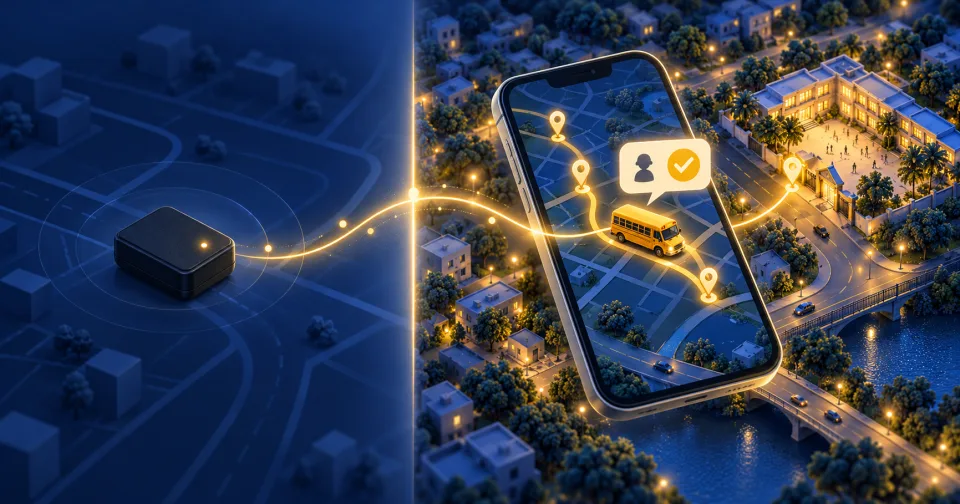
- A digital safety monitoring system on every school bus and van: a vehicle location tracking device, linked to the state's monitoring platform, meeting AIS-140 standards.
- CCTV on board, with at least 30 days of footage kept and shared with transport, education or police officials when asked.
- Digital attendance: a daily record of every child's boarding and drop-off time.
- A parent app with live tracking, attendance and automatic alerts.
- A lady attendant or designated staff member on every trip for children up to Class 5.
- Written appointment, background verification and medical fitness records for drivers and attendants, open to inspection.
Reports at the time said existing vehicles were given about three months to comply. Whichever state you are in, the direction is clear: regulators now expect a school to prove where each child was, not just say the bus was safe.
Ready for digital attendance and live tracking?
BOBOK records every child's boarding and drop with a QR scan, shows parents the bus live, and alerts them automatically — in English and Hindi.
Paperwork that protects your school
Most problems in an inspection are not about the bus. They are about missing papers. Keep these in one folder, physical or digital, for every vehicle:
- Registration, fitness certificate, permit, insurance and pollution certificate, with renewal dates
- Speed governor and tracking device certificates
- Driver's licence copy, experience proof, police verification and latest medical report
- Attendant's appointment letter, police verification and training record
- Route chart with stops, timings and the children assigned to each stop
- Daily boarding and drop records
- A log of complaints, incidents and what was done about them
A simple rule: if a parent or an officer asked you tomorrow "who was on bus 4 at 7:40 on Monday?", could you answer in under a minute? If not, that is the gap to close first.
A daily checklist for your transport desk
Rules matter, but safety happens in the ten minutes before the bus leaves. A short routine, done every day, catches most problems early.
Before the first trip
- Driver and attendant present, sober, in uniform with ID
- Tyres, lights, horn, wipers and doors checked
- First-aid box and fire extinguisher in place and not expired
- Tracking device on and reporting, phone charged
During pickup and drop
- Every child marked when they board and when they get down
- A child handed over only to a parent or an authorised person
- Parents of an absent child informed before the bus moves on
After the last trip
- Bus walked end to end to make sure no child is left on board
- Any incident, delay or complaint written down the same day
Common gaps we see
In conversations with schools, the same few gaps come up again and again:
- Hired vans treated differently. Vans and private operators carrying your students are usually covered by the same rules. Put the same checks in their contract.
- Attendance on paper only. A paper register cannot alert a parent in real time, and it is hard to search later.
- Verification done once. Police verification and medical checks need renewing, and replacement drivers often skip them.
- No single owner. When transport is "everyone's job", nobody notices an expired fitness certificate.
Fixing these does not need a large budget. It needs one person responsible, a checklist, and records you can find quickly. If you are comparing tools to help, our guide on GPS trackers versus school transport apps explains what to look for, and the BOBOK page for schools shows how we handle it.
Questions people ask
Is GPS mandatory on school buses in India?
What is the speed limit for a school bus?
Do vans and private operators have to follow the same rules?
Sources

We build school transport safety software for schools in India. Our guides are researched from official notifications and reviewed before publishing.