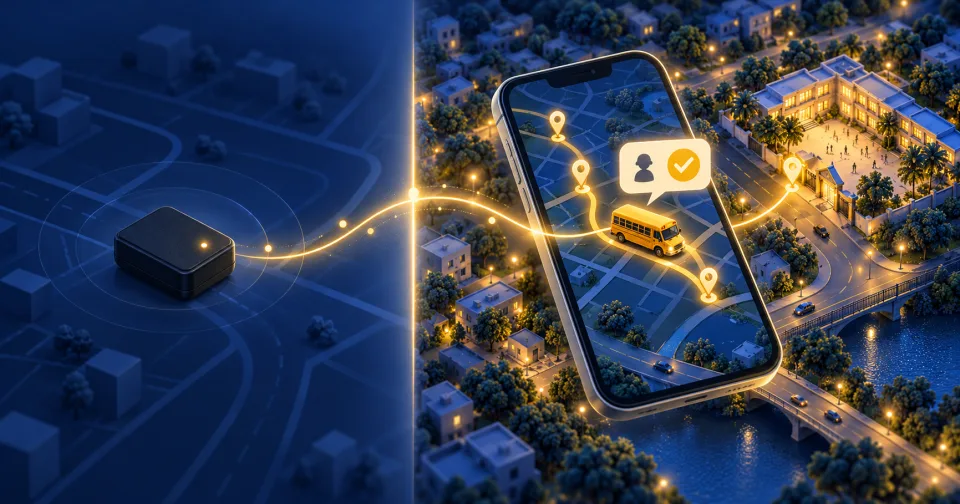
7 questions every parent should ask about the school bus
Who checks the driver? Who tells you if your child is not on the bus? Seven simple questions, why each one matters, and what a good answer sounds like.

On this page
- 1. Who is driving, and how were they checked?
- 2. Is there an attendant on every trip?
- 3. If my child is not on the bus, who tells me, and how fast?
- 4. Who can collect my child at drop-off?
- 5. How fast does the bus go, and how many children are on it?
- 6. What happens in an emergency?
- 7. What data do you collect about my child, and who sees it?
- How to ask, without starting a fight
- Warning signs worth raising
- Questions people ask
The short version
- You do not need to be an expert to judge your child's school bus. Seven simple questions tell you most of what you need to know.
- The most important one: if your child is not on the bus, who tells you, and how fast?
- Ask politely, ask in writing if you can, and ask together with other parents. Good schools are glad to answer.
Every parent knows the feeling: the bus was supposed to drop your child at 2:10, it is now 2:35, and nobody is answering the phone. School bus safety for parents usually comes down to a handful of questions that most of us never think to ask until something goes wrong.
Here are seven questions to ask your school about transport, why each one matters, and what a good answer sounds like.
1. Who is driving, and how were they checked?
The driver is responsible for 30 or 40 children at a time. Rules followed by most schools, such as CBSE's transport guidelines, expect a driver with a valid heavy-vehicle licence, at least five years of experience driving heavy vehicles, no record of over-speeding or dangerous driving, a yearly medical check including eyesight, and police verification.
A good answer: "Yes, every driver is verified, and we re-check when a driver is replaced." Ask specifically about replacement drivers. They are the ones most often missed.
2. Is there an attendant on every trip?
A driver cannot watch the road and 40 children at once. A trained attendant helps children on and off, keeps them seated and handles problems on the way. For young children, many schools have a woman attendant, and some states now require one: Maharashtra's 2026 rules ask for a lady attendant or designated staff member on every trip carrying children up to Class 5.
A good answer: "Every trip has an attendant, and you can see their name and number in the app or on the bus."
3. If my child is not on the bus, who tells me, and how fast?
This is the most important question on the list. Children miss the bus, get on the wrong one, or get down at the wrong stop. What matters is how quickly an adult notices and tells you.
A good answer: "Children are marked when they board and when they reach school. If your child is not marked, you get an alert, and the transport in-charge calls you." A weak answer is "the attendant would know". Ask how.
4. Who can collect my child at drop-off?
At drop-off, a child should be handed only to a parent or to a person you have authorised. If nobody is at the stop, the school should have a clear plan, for example keeping the child on the bus and bringing them back to school, rather than leaving them at the stop.
A good answer: "Only to you or the people on your list. If nobody is there, we call you, and the child stays with us."
Want this for your child's school?
With BOBOK, parents see the bus live, get an alert when their child boards and reaches, and the handover at drop is recorded. Share this with your school.
5. How fast does the bus go, and how many children are on it?
School buses are expected to have a speed governor that keeps them at or below 40 km/h. They should also carry no more children than the seats allow. Overcrowding is common in vans and smaller vehicles, and it is one of the easiest problems for parents to notice.
A good answer: "Every bus has a speed governor, and we check route speed in the tracking system. No child stands." If your child often mentions sharing seats or standing, raise it.
6. What happens in an emergency?
Breakdowns, traffic jams, heavy rain and accidents happen. Ask what the crew is trained to do, how the school is told, and how you will be told.
A good answer: "The bus has a first-aid kit, a fire extinguisher and a phone. The crew calls the transport in-charge, and parents on that route get a message with an update." Bonus points if the school runs a short drill with the crew each year.
7. What data do you collect about my child, and who sees it?
If the school uses an app or GPS, it is collecting your child's location and attendance. Under India's data protection rules, schools and their transport providers may track children for their safety during the journey, but they must protect that data and not use it for anything else, such as advertising.
A good answer: "Location is used only for the journey and your child's safety. It is stored securely, only staff who need it can see it, and it is deleted after a set time." You can read more in our guide to the DPDP Rules for schools.
How to ask, without starting a fight
- Ask together. A question from the parents' committee or a group of parents on the same route gets a better hearing than one angry call.
- Ask in writing. A short, polite email gets a considered reply and leaves a record.
- Ask to see, not just hear. "Can we see the attendance record for last week?" is a fair request.
- Say thank you. Drivers and attendants do a hard job. Recognising the good ones makes the whole system better.
Warning signs worth raising
- A new driver every few weeks, with no one explaining why
- No attendant on some trips
- Your child is regularly the last one dropped, an hour after school ends
- Children standing, or sitting three to a seat
- Nobody can tell you, on the day, whether your child boarded
None of these means something bad will happen. But each one is worth a calm conversation with the school. If you want to understand the rules schools are expected to follow, our school bus safety rules checklist explains them in plain words, and the BOBOK page for parents shows what the app looks like.
Questions people ask
What should I do if the school bus is late and nobody answers?
Should young children have a woman attendant on the bus?
Can I ask to see my child's bus attendance record?
Sources

We build school transport safety software for schools in India. Our guides are researched from official notifications and reviewed before publishing.