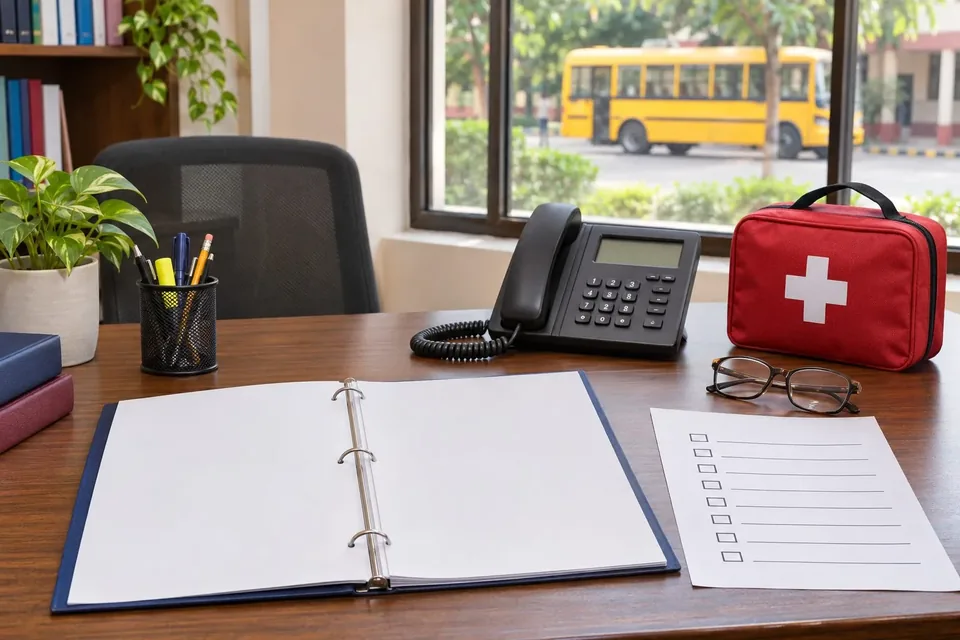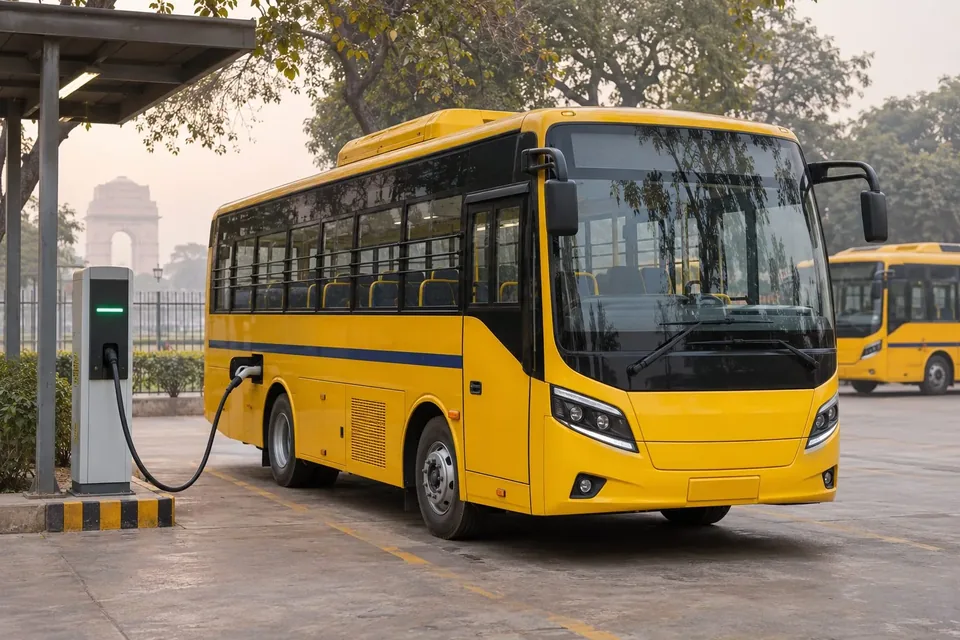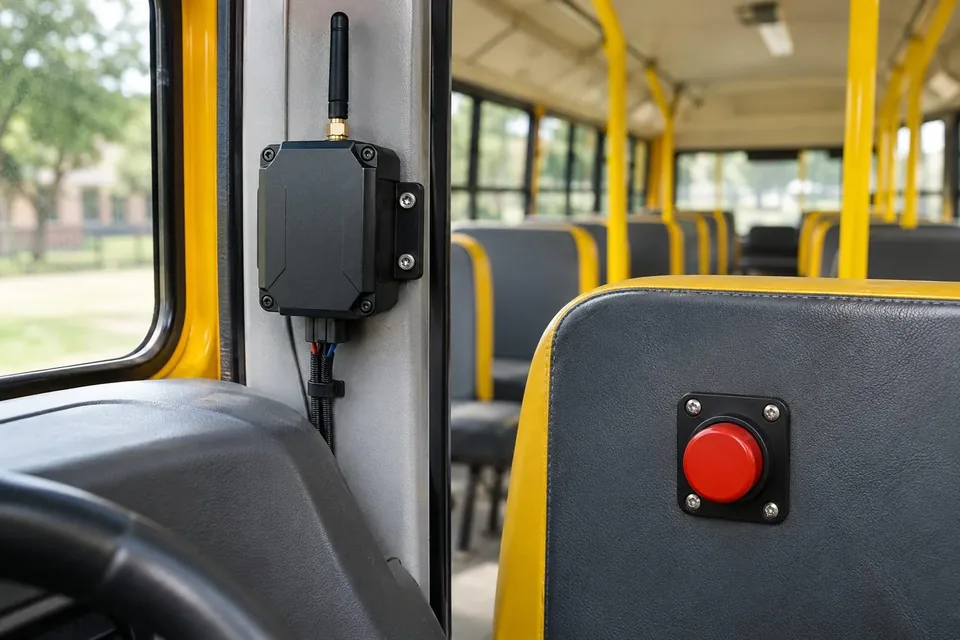
School Safety and Security Guidelines 2021: a practical checklist for school management
The School Safety and Security Guidelines 2021 make school management accountable for children's safety, including on the journey to and from school. Here is what they ask for, in plain English, with a 30-day plan.

On this page
- What the school safety and security guidelines 2021 are and why they were issued
- Who is accountable: management, principal, staff
- The areas covered
- The journey to and from school: what the guidelines say on transport
- Records a school should be able to produce
- How the NCPCR manual fits alongside
- Checking whether your state has notified the guidelines
- A 30-day action plan for a school starting from zero
- What to do next
- Questions people ask
Last reviewed: November 2026
The School Safety and Security Guidelines 2021 are the Ministry of Education's framework for fixing accountability for children's safety on school management, the principal and staff, including while children travel to and from school in school transport. They are advisory and take effect in a state once it notifies them, but in August 2024 the Ministry asked every state and union territory to implement them and report back.
Key points
- Issued by the Department of School Education and Literacy in October 2021, following Supreme Court directions.
- Accountability sits with management and the head of school, in private and government schools alike.
- The guidelines list eleven kinds of negligence and, for private schools, graded fines and loss of recognition for repeated non-compliance.
- Transport is covered: fitness certificates, an attendant, verified drivers, marked stops.
- Schools are expected to inspect quarterly and publish the reports.
What the school safety and security guidelines 2021 are and why they were issued
The Department of School Education and Literacy (DoSEL) in the Ministry of Education sent the "Guidelines on School Safety and Security" to states on 1 October 2021. They were prepared in compliance with Supreme Court directions in writ petitions filed in 2017 on the safety of children in schools, and are aligned with the POCSO framework.
The document does three things. It sets out the legal framework and an accountability structure. It describes a "whole school safety" approach, in which management, principals, teachers, students, parents and non-teaching staff each have defined roles. And it covers prevention, reporting, support and counselling. Most of the pages that rank for the school safety and security guidelines 2021 are the government PDF itself, which runs to well over a hundred pages. This post is the short version.
Who is accountable: management, principal, staff
The purpose statement is direct. The guidelines aim to fix accountability for keeping children safe and secure in schools, "including while children are transported to and fro" in school transport. In private and unaided schools, that accountability is placed on the school management, principals and teachers. In government and government-aided schools, it is placed on the head of school, teachers and the education administration.
The guidelines list eleven categories of negligence that can make management accountable, including unsafe infrastructure, weak security, delayed medical aid, failing to act on a child's complaint, corporal punishment, failing to prevent bullying or substance abuse, a lack of regular monitoring, delayed action in a crime or disaster, and suppressing or not reporting facts.
For private schools, section 4.4 sets out graded consequences after an enquiry by the district authority: a fine of 1% of the previous year's revenue for a first non-compliance, 3% for a second and 5% for a third, possibly with a bar on admissions for the following year. Persistent non-compliance can lead to temporary or, in extreme cases, permanent withdrawal of recognition. For government schools, the route is disciplinary and administrative action.
The areas covered
The guidelines are long because they try to cover every way a child can come to harm. For planning, it helps to group them into six areas.
- Buildings and emergencies. Structural safety, fire safety, disaster preparedness and drills, safe storage of hazardous material.
- Health and hygiene. Safe drinking water, food quality, first aid, prompt medical attention.
- Protection from abuse. POCSO awareness, a grievance committee on child sexual abuse, and the duty to report.
- Emotional safety. No corporal punishment or harassment, an anti-bullying committee, attention to discrimination and substance abuse.
- The journey. Transport to and from school, and safe arrival and dispersal.
- Monitoring and reporting. A school safety committee, safety walks, quarterly inspections, training and records.
Who does what in the whole school safety approach
The guidelines give every group a role, which is useful when you are deciding who owns each task:
- Management sets the safety plan, funds it, holds quarterly reviews and constitutes the committees.
- The principal runs the plan day to day, makes sure incidents are reported to the authorities, and acts when an offence is reported.
- Teachers and non-teaching staff watch for risks, report concerns and take part in training.
- Parents follow the school's safety rules, keep contact details current and raise concerns early.
- Students learn the rules, including how to behave on and around school vehicles, and are represented in safety meetings.
Writing a name next to each task is the simplest way to turn the guidelines into practice.
The journey to and from school: what the guidelines say on transport
Section 5.19 and the school transportation part of the inspection checklist (Annexure III) list what schools should have in place:
- A fitness certificate for every vehicle used to transport children to and from school.
- The school's name, address and phone number displayed on those vehicles.
- A responsible staff member on the bus to manage safe boarding, getting off and accompaniment.
- Driving licences of all drivers verified before they drive.
- A female attendant or teacher on all school buses.
- Students taught how to behave on and around vehicles.
- Marked boarding and drop-off points, with parents told where the nearest stop is.
- A stocked first aid box on every bus, checked for expiry.
- Regular maintenance of school vehicles.
The guidelines also say parents may be encouraged to use school buses rather than private vans where that is affordable, and that students should wear ID cards, showing a parent's name and mobile number, on their way to and from school.
A school using BOBOK has a time-stamped trail for each child on that journey: the QR scan when the child boards, the check-in at the school gate, and the handover at the home stop to an authorised person. That trail is the kind of record an inspection or an enquiry will ask for. For the rules that apply to the bus itself, see our school bus safety rules checklist.
Records a school should be able to produce
Accountability is proved with paper. The guidelines expect, among other things:
- Quarterly school inspection reports, signed and uploaded to the school website.
- Minutes of School Safety Committee meetings and the outcome of safety walks.
- Minutes of quarterly meetings with the school management committee, teachers, parents and students.
- Records of staff safety training, with certification.
- Decisions of the anti-bullying and child sexual abuse grievance committees.
- An up-to-date contact list of parents for every student, and phone numbers for staff and bus drivers.
- Vehicle fitness certificates and driver licence checks.
Many of these records contain personal data about children. Keep them secure and limited to what you need; our post on the DPDP Rules and child tracking explains a school's duties.
How the NCPCR manual fits alongside
The National Commission for Protection of Child Rights (NCPCR) published a "Manual on Safety and Security of Children in Schools", which brings together existing guidelines, circulars and orders on school safety, including CBSE's transport circular. Its first version is dated February 2018, and an updated version from September 2021 is on the NCPCR website. It includes a child safety checklist.
The two documents work together. The 2021 guidelines ask management to comply with the NCPCR manual and to carry out quarterly inspections using either the NCPCR checklist or the comprehensive checklist in Annexure III of the guidelines.
Checking whether your state has notified the guidelines
Because the guidelines are advisory, they bind schools in a state once that state notifies them, with any additions it chooses. On 23 August 2024 the Ministry of Education, through a PIB release, asked all states and union territories to implement the guidelines and tell it the status of notification.
To find your state's position:
- Search your state school education department's website and gazette for "School Safety and Security".
- Check circulars from your directorate of education. Delhi's Directorate of Education has circulated the guidelines to schools and directed heads of school to implement them; look on edudel.nic.in for the latest circular.
- Ask your district education officer or zone office in writing.
Even if your state has not notified them yet, the guidelines describe what an enquiry will expect of a careful school. Waiting for a notification is a risky plan.
A 30-day action plan for a school starting from zero
Week 1: set up. Constitute the School Safety Committee and name a nodal person. Download the guidelines and the Annexure III checklist. Fix a date for the first quarterly inspection.
Week 2: inspect. Walk the school with the committee using the checklist, section by section, including the buses. Mark each item as in place, partly in place or missing. Photograph what you find.
Week 3: fix the urgent items. Start with anything that could hurt a child tomorrow: blocked exits, expired fire extinguishers, a bus without an attendant, an unverified driver. Set up the anti-bullying and grievance committees if they do not exist.
Week 4: write it down. Prepare the school safety and security plan, sign the inspection report, upload it to the website, and share the plan with parents at the next meeting. Book the next quarterly inspection and the staff training.
Keep the plan realistic. A school that fixes ten things properly in the first month is in a better position than one that lists sixty and finishes none. Record what is still open, with an owner and a date.
After the first month, the work becomes a routine: inspect every quarter, record what you found, fix it, and keep the evidence.
What to do next
Download the official guidelines from the Ministry of Education's DoSEL website and print Annexure III. Put the first inspection in the calendar this week. If transport is part of your school's service, start with the bus checklist above.
If you want to see how BOBOK gives your school a dated record of each child's journey, book a demo.
This article is general information, not legal advice. Following these steps does not by itself make a school compliant; check your state's notification and your board's rules.
Questions people ask
Are the 2021 school safety guidelines mandatory?
Who is held accountable if a child is harmed at school?
Do the guidelines cover the school bus?
Where can I download the official guidelines?
Sources
- Guidelines on School Safety and Security, 2021
- Ministry of Education directs all States/UTs to implement Guidelines on School Safety and Security (PIB, 23 Aug 2024)
- Manual on Safety and Security of Children in Schools (Sep 2021)
- Rajya Sabha reply (4 Dec 2024) on school safety guidelines and the NCPCR manual
We build school transport safety software for schools in India. Our guides are researched from official notifications and reviewed before publishing.