Is an AIS 140 GPS device mandatory for school buses in India?
Vendors often say an AIS 140 device is compulsory in every school bus. The real answer depends on who owns the bus and how it is registered. Here is what the rule says.

On this page
Last reviewed: November 2026
AIS 140 school bus rule: the short answer
An AIS 140 school bus device is mandatory when the bus is a public service vehicle, which usually means a bus hired from an operator on a permit. Rule 125H of the Central Motor Vehicles Rules requires such vehicles registered on or after 1 January 2019 to carry an AIS 140 tracking device and emergency buttons; older ones follow dates set by each state. A bus owned by the school and used only for its students is defined separately in the law, so check your state's position. In Delhi, the transport authority has directed all bus operators to keep tracking devices and panic buttons working.
Key points
- AIS 140 is the technical standard for vehicle location tracking devices (VLTDs) and emergency buttons.
- Rule 125H covers public service vehicles, except autorickshaws and e-rickshaws.
- New public service vehicles registered from 1 January 2019 cannot be registered without the device.
- States set dates for older vehicles and check fitment at fitness renewal.
- A parent or school tracking app is useful, but it does not replace a device the law requires.
What AIS 140 is, in plain words
AIS stands for Automotive Industry Standard. AIS 140 is the standard that sets out how a vehicle location tracking device and its emergency (panic) button must work, how they are tested and how they send data. Rule 125H says the device and button must meet AIS 140 until a corresponding Bureau of Indian Standards specification is notified.
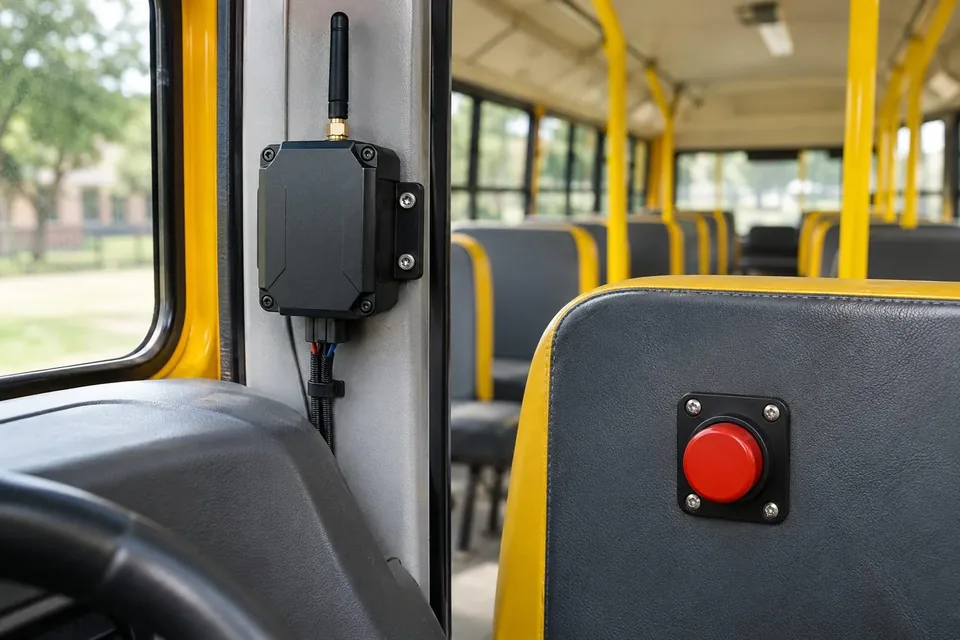
In practice, an AIS 140 device is a tracker wired into the vehicle, with its own SIM, that reports the vehicle's location to a state-run monitoring backend. When someone presses the emergency button, an alert goes to that backend so authorities can respond. The device must be type-approved by a recognised testing agency, and fitted by the vehicle manufacturer, its dealer, or the operator.
Which vehicles the central rule covers
The Ministry of Road Transport and Highways inserted Rule 125H through notification G.S.R. 1095(E) dated 28 November 2016. It says all public service vehicles must be fitted with a vehicle location tracking device and one or more emergency buttons. After deferrals, a further notification in October 2018 (S.O. 5454(E)) made the device compulsory for new public service vehicles registered on or after 1 January 2019. For vehicles registered up to 31 December 2018, each state or union territory notifies its own deadline. Autorickshaws and e-rickshaws are exempt.
The key phrase is "public service vehicle". Under section 2(35) of the Motor Vehicles Act, that means a vehicle used to carry passengers for hire or reward. A bus that a school hires from an operator, running on a contract carriage permit, fits that description. An "educational institution bus" is defined separately in section 2(11) as a bus owned by a school or college and used only to carry its students or staff. Whether your state applies Rule 125H to school-owned buses is a question for your state transport department, and the answer can change with new orders.
How states enforce it, and the position in Delhi
States enforce Rule 125H mainly at registration and fitness. MoRTH guidance asks states not to register new public service vehicles without the device, and to check fitment and working status when a vehicle's fitness certificate is renewed. States run monitoring centres that receive the tracking data and emergency alerts.
In Delhi, the Transport Department publishes circulars listing type-approved devices under Rule 125H. In an order dated 31 August 2026, Delhi's State Transport Authority directed all bus operators in the city to keep their tracking devices and panic buttons functional at all times, and repeated that school buses must carry an authorised attendant where required. If your school runs or hires buses in Delhi, treat a working VLTD and panic button as expected on every bus, and confirm the details of the order with the Transport Department.
Tracking device versus tracking app: what each one does
| AIS 140 device (VLTD) | School bus tracking app | |
|---|---|---|
| Purpose | Legal compliance and public safety monitoring | Information for the school and parents |
| Who sees the data | The state monitoring backend | The school, and parents for their own child |
| Emergency button | Physical panic button wired to the state backend | Depends on the app; often an SOS from the driver to the school |
| Knows which child is on board | No | Yes, if boarding is recorded, for example by QR scan |
| Required by law | Yes, for vehicles covered by Rule 125H | No |
The two answer different questions. The device tells the state where the vehicle is. An app tells a parent whether their child got on, and when the bus will reach the stop. Our post on GPS trackers versus school bus tracking apps goes into the difference in more detail.
BOBOK is an app of the second kind. It gives the school and parents live bus tracking, arrival times and a scan record of each child's boarding and drop. It does not replace an AIS 140 device where the law requires one, and a school should not treat it as a substitute.
What to ask your bus contractor
- Is each bus registered as a public service vehicle, and on what permit?
- Does each bus have a type-approved VLTD and emergency buttons? Please share the fitment certificate.
- Is the device connected and reporting to the state backend now?
- When did the last fitness inspection check the device, and what was the result?
- Who maintains the device and its SIM, and how quickly is a fault fixed?
- Will you inform the school if a device stops working?
- When were the panic buttons last tested, and did the alert reach the control room?
The last question matters more than it looks. A panic button that has never been pressed is a button nobody knows works. Ask for a test at the start of each term, with a record of the result.
Put the answers in the contract. If a bus fails at fitness because the device is missing, it is your children who lose their ride.
Common myths
"Any GPS tracker counts as AIS 140." It does not. The device has to be type-approved against the standard and connect to the state backend.
"A tracking app on the driver's phone meets the rule." It does not. A phone app is not a fitted, type-approved device.
"AIS 140 lets parents see the bus." Not by itself. The data goes to the state, not to parents.
"Only new buses need it." New public service vehicles need it from registration. Older ones follow the deadline their state sets.
"CBSE's GPS rule means AIS 140." CBSE's 2017 circular asks for working GPS and CCTV in every school bus. It does not name AIS 140. A device that meets AIS 140 will usually satisfy CBSE's GPS requirement too.
What to do next
List every bus you run or hire, mark whether it is school-owned or hired, and ask for the VLTD fitment certificate for each hired bus. For school-owned buses, write to your state transport department or local transport authority and ask whether Rule 125H applies. For the wider set of rules, see our school bus safety rules checklist.
To see how BOBOK works alongside the devices on your buses, book a demo.
This article is general information, not legal advice. Rules on tracking devices change through state orders, so confirm the current position with your transport department.
Questions people ask
What is AIS 140?
Is a panic button compulsory in a school bus?
Can a mobile app replace an AIS 140 device?
Who pays for the device - the school or the bus owner?
Sources
- Letter on Vehicle Tracking System guidelines under Rule 125H
- Lok Sabha unstarred question 755: notifications G.S.R. 1095(E) and S.O. 5454(E) on VLT devices
- Circular dated 2 November 2024 on type-approved vehicle tracking devices under Rule 125H
- Central Motor Vehicles Rules, 1989 and amendments (Rule 118, Rule 125H)
- Rajya Sabha reply citing CBSE circular CBSE/AFF/Circular-8/2017 dated 23.02.2017 (PQ 243, 20 Jul 2017)
We build school transport safety software for schools in India. Our guides are researched from official notifications and reviewed before publishing.