CBSE school bus guidelines: what every affiliated school must have in place
The CBSE school bus guidelines ask for GPS, CCTV, a 40 km/h speed governor, a lady attendant and a named transport manager. Here they are as a checklist, with who owns each item and what proof to keep.

On this page
- What the CBSE circular is, when it was issued and which schools it covers
- The bus itself: exterior markings, windows, doors, emergency exits
- Equipment on board: GPS, CCTV, speed governor, first-aid box, fire extinguisher
- People: driver, attendant, transport manager - who is required and what each does
- What the school management must do and record
- What the circular asks of parents
- What a lapse can cost the school
- One-page CBSE school bus guidelines checklist
- How software helps you keep the proof
- What to do next
- Questions people ask
Last reviewed: November 2026
The CBSE school bus guidelines require every affiliated school's buses to have working GPS and CCTV, a speed governor capped at 40 km/h, window grills, first aid and fire extinguishers, a trained lady attendant and a named transport manager. They come from CBSE circular CBSE/AFF/Circular-8/2017, dated 23 February 2017, and the school's management and head are held responsible for any lapse.
Key points
- The circular applies to all CBSE-affiliated schools that provide transport.
- Equipment: GPS, CCTV, speed governor (40 km/h), first aid box, fire extinguishers, an emergency phone.
- People: a qualified driver, a well-trained lady attendant, and a designated transport manager.
- Parents are asked to share responsibility, including a parent volunteer on each bus where possible.
- CBSE says lapses can lead to action up to cancellation of affiliation.
What the CBSE circular is, when it was issued and which schools it covers
CBSE issued the circular on 23 February 2017, after a run of school bus accidents that year. In a reply in the Rajya Sabha in July 2017, the Ministry of Human Resource Development confirmed the circular number and summarised its main requirements. CBSE said it drew on the Supreme Court's directions, the Motor Vehicles Act and state government orders.
The CBSE school bus guidelines cover every school affiliated to the board, including Kendriya Vidyalayas. They are grouped into broad areas: the outside of the bus, equipment, people on board, facilities, and the duties of the school and parents. CBSE has since reminded schools of its earlier safety circulars, for example in Circular 01/2022 on the safety of children in schools.
The circular sits alongside your state's motor vehicle rules, not in place of them. Where the state rule is stricter, follow the state rule as well. Our school bus safety rules checklist brings the central and state layers together.
The bus itself: exterior markings, windows, doors, emergency exits
A parent or a traffic officer should be able to identify a school bus at a glance. The circular asks for:
- The bus painted yellow, with the school's name written clearly on both sides.
- "School Bus" written on the front and back. A hired bus should show "On School Duty".
- The driver's name, address, licence number and badge number, the school's or owner's phone number and the transport department helpline displayed on the bus.
- Windows fitted with horizontal grills and wire mesh, so no child can put a head or arm out.
- Doors with reliable locks, and seats of non-combustible material.
- Space under the seats for school bags, so aisles stay clear.
For emergency exits, the requirement comes from the bus body standard the vehicle was approved under. Check at every fitness renewal that the exit opens freely and is not blocked by seats or luggage.
Equipment on board: GPS, CCTV, speed governor, first-aid box, fire extinguisher
This is the section most schools are asked about first.
- GPS and CCTV. The circular says both must be installed in every school bus and kept in working condition at all times. It places the upkeep on the bus owner, which matters if your buses are hired.
- Speed governor. Fitted with a maximum speed of 40 km/h. See our explainer on the school bus speed limit for how this compares with central rules.
- First aid box on every bus, stocked and in date.
- Fire extinguishers, with the driver, conductor and attendant trained to use them.
- Alarm bell or siren for emergencies.
- A mobile phone in the bus for use in an emergency.
"Installed" is not the test; "working" is. A CCTV unit with a full memory card or a GPS device whose SIM has lapsed fails the requirement just as a missing one does. If you are weighing what kind of tracking to use, our post on GPS trackers versus school bus tracking apps sets out the difference.
People: driver, attendant, transport manager - who is required and what each does
Driver. A valid driving licence and at least five years' experience of driving heavy vehicles. The driver should not interact with children beyond what the job needs.
Conductor. Where state rules require one, a qualified conductor with a valid licence. In Delhi this comes from Rule 17 of the Delhi Motor Vehicles Rules, 1993.
Lady attendant. The school must provide at least one well-trained lady attendant, preferably a lady guard, on each bus to look after the children travelling on it.
Transport manager. Each school should designate one transport manager who is responsible for the safety of children travelling by bus. That person's name and contact number must be displayed inside and outside each bus.
The circular also says no outsider may board, apart from the driver, conductor, the authorised attendant and a parent volunteer.
What the school management must do and record
The circular puts the duty on management and the head of school. In practice that means a small set of habits:
- Name the transport manager in writing and give them the authority to stop a bus that is not fit to run.
- Check every driver's licence, experience and verification before the first trip.
- Test GPS, CCTV and the governor at the start of each term and after any repair.
- Collect student feedback on the transport facility, especially about the driver. The circular asks for this.
- Keep a file per bus and per driver, so you can show an inspector what you checked and when.
What the circular asks of parents
CBSE is clear that safety on the school run is shared. The circular says parents are equally responsible for their children's safety during school journeys. It asks schools to work out, with parents, a voluntary arrangement so that at least one parent travels in each bus to oversee the driver and staff. Parents are also asked to report any concern about a driver or attendant to the school.
A rota of parent volunteers is easier to run than it sounds when a school shares it at the start of term. For more on what parents can reasonably ask, see our seven questions every parent should ask about the school bus.
What a lapse can cost the school
CBSE says the management and the head of school will be held responsible for any lapse and may face action, including cancellation of affiliation under its rules. That is the board's sanction. Separately, a school can face action under motor vehicle law, and the Ministry of Education's 2021 school safety guidelines hold management accountable for children's safety while they are transported to and from school. The cost of a lapse is rarely only one of these.
One-page CBSE school bus guidelines checklist
| Requirement | Who owns it | Proof to keep |
|---|---|---|
| Yellow paint, school name, "School Bus" / "On School Duty" | Bus owner | Dated photos of each bus |
| Driver and helpline details displayed | Transport manager | Photo of the display, updated when the driver changes |
| Window grills with mesh, lockable doors | Bus owner | Fitness certificate, dated photos |
| GPS working | Bus owner | Device certificate, monthly check log |
| CCTV working | Bus owner | Monthly footage spot-check log |
| Speed governor at 40 km/h | Bus owner | Fitment certificate showing setting, seal photo |
| First aid box, fire extinguishers | Transport manager | Expiry check log, training record |
| Emergency phone on board | Transport manager | Number list, monthly test |
| Qualified driver, five years' experience | School and contractor | Licence copy, experience proof, verification |
| Trained lady attendant | School | Appointment letter, training record |
| Transport manager named and displayed | Management | Appointment order |
| Parent volunteer arrangement | School with parents | Rota, circular to parents |
| Student feedback on transport | School | Feedback forms, action taken |
How software helps you keep the proof
Most of the checklist is physical: paint, grills, people. Software cannot fit a grill. What it can do is keep a dated record that the daily routine actually happened.
BOBOK keeps a time-stamped record of every boarding and drop scan, every trip and every SOS alert raised by a driver. When someone asks who was on the 7:10 bus last Tuesday, or when a child was handed over, the school can answer from the record rather than from memory. BOBOK is a technology provider; the school still runs its transport and remains responsible for it, and using BOBOK does not by itself make a school compliant with the circular.
What to do next
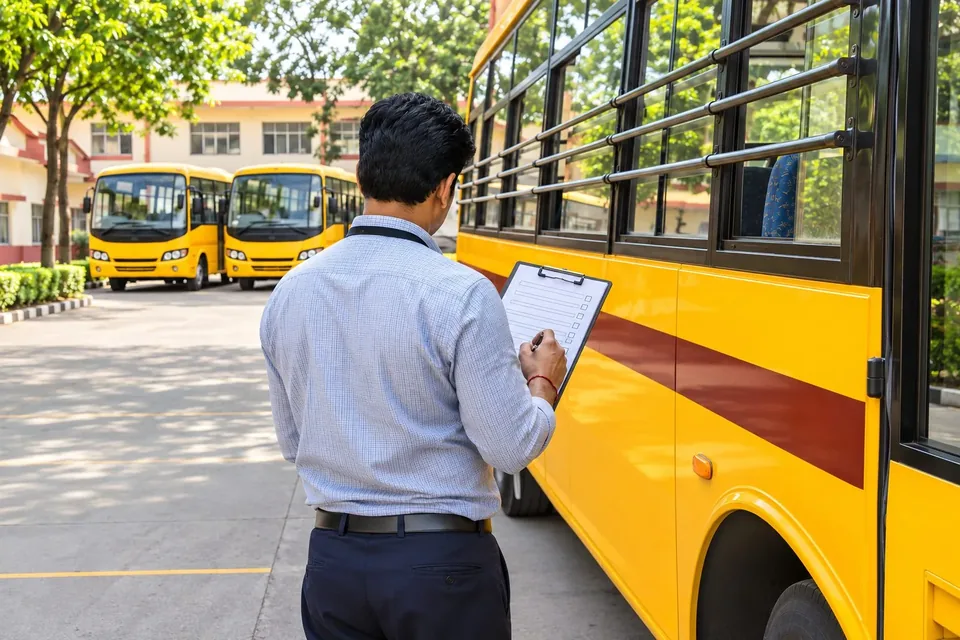
Print the checklist above and walk one bus with your transport manager this week. Mark each line as met, partly met or not met, and fix the "not met" items before the next term. Then make the checks routine.
If you would like to see how BOBOK records boarding, drop and trip data for your buses, book a demo.
This article is general information, not legal advice.
Questions people ask
Is GPS mandatory in CBSE school buses?
Is a lady attendant compulsory in every school bus?
Do the guidelines apply to buses hired from a contractor?
Can a school lose CBSE affiliation over bus safety?
Sources
- Rajya Sabha reply citing CBSE circular CBSE/AFF/Circular-8/2017 dated 23.02.2017 (PQ 243, 20 Jul 2017)
- Circular No. 01/2022 - Safety of children in schools
- M.C. Mehta v. Union of India, order dated 16 December 1997 (W.P.(C) 13029 of 1985)
- DoE endorsement dated 22.06.2018 forwarding Traffic Police letter, School Cab Scheme and Delhi Motor Vehicles Rules extracts
- Guidelines on School Safety and Security, 2021
We build school transport safety software for schools in India. Our guides are researched from official notifications and reviewed before publishing.